Friday, 20 April 2012

What did Jesus Accomplish on the Cross? A Particular Baptist Reply

John Calvin
We have already noted a significant question for early English Baptists: what did Jesus accomplish by his life, death and resurrection?   John Calvin answered this in a very clear cut, but fundamentally different manner, to that of his successor, Jacob Arminius. 

To understand Calvin’s significance it is important to outline his life and his broad theological principles, before looking at the narrower issue of predestination.  John Calvin [1509-64] a French Roman Catholic, trained as a lawyer at the Sorbonne in Paris, studied the writings of Luther and other theologians, and in 1532, like them underwent a deep evangelical religious experience. ‘God subdued my heart’ he wrote, ‘to docility by a sudden conversion’.

 He was forced to leave France and it was while he was passing through Geneva that he was persuaded to become the city’s ‘reader in Holy Scripture’. Here Calvin published The Institutes of the Christian Religion in 1536, a classic statement of the whole of his reformed theology, which was revised continually throughout his life.  He was persuaded to become the organizer of ‘the reformation’ in Geneva, and in 1541 began his work, remaining there as the ‘unopposed dictator’ of a theocratic regime in the city till 1564. 

The government of this new reformed church was by a consistory church court, which could excommunicate unrepentant church members, and had far reaching authority over the private lives of every citizen. In Geneva people saw a theocratic state in action, and many in England thought it the best model of a reformed church.  English separatists who took refuge there responded warmly to Calvin’s revolutionary proposals for a new church structure, and sought a reformation in England advocating the Geneva model.  However, Queen Elizabeth 1 would not tolerate it.  In Scotland John Knox led the introduction of Calvin’s model for church and state.


English Separatist Christians, meeting outside Church of England structures, began to form ‘gathered churches’, established on Calvin’s principles. Henry Jacob led one such Independent Calvinist congregation as early as 1616.  By 1630, this church was led by John Lathrop, the congregation insisting upon a complete separation of church and state, rejecting the ‘parish’ system of Anglicanism.  Ten years later, in May 1640, Henry Jessey was the pastor.  This Calvinist orientated congregation discussed believers’ baptism in the 1640s, and by 1644 believers’ baptism had become the norm for admission to this congregation.  By 1644 seven other London Baptist congregations signed a common statement of their faith and practice.  Calvinist Baptist congregations grew steadily.

In the time of Oliver Cromwell, Baptist Christians in the Parliamentary army spread Calvinist Baptist churches around the country.  It was the English Civil War that led the Broadmead, Bristol congregation to leave ‘Royalist’ Bristol, and migrate to London where they joined with a Calvinist Baptist congregation under the leadership of William Kiffin.  Once Cromwell was ruling the country, Broadmead Christians returned to Bristol, to be led by Matthew Hazzard, his wife Dorothy, and later Thomas Ewins.

Calvinism maintains that the Bible alone contains all that is necessary to know God and our duties towards God and our neighbour.  Calvinist theology asserted that before the Fall, man was in a state of innocence and could attain to holy living.  But the Fall, which was willed by God, substantially changed human nature, so that man no longer had free will.  All human works outside the Christian faith were sins, and even the good works of Christians were intrinsically evil.  However, the imputed merits of Christ won at Calvary covered humanities intrinsic evil, and they were not counted as such.  Calvin argued that before the Fall, even before the creation of the world, God in his wisdom predestined some of humanity, his elect, to salvation and the rest to damnation.

In a recent Baptist Quarterly [January 2011] an article claims that The True Calvinist is a Baptist.   This may be true but to-day’s English Baptists are certainly not Calvinist, but are more accurately termed Arminian.  When Baptist churches in the mid-eighteenth century awoke to the missionary challenge of Andrew Fuller and William Carey, they modified their Calvinism without becoming fully Arminian, because ‘high Calvinism’ had to all intents and purposes, reduced the missionary task of the Church to helping the elect of God to recognise their calling.  Calvin’s assertion of predestination was meant to maintain the sovereignty God, but it effectively reduced God’s elect to a very small number, when set within the context of the vast populations on earth that Carey discovered, when reading of the voyages of Captain Cook.  Arminius, on the other hand, maintained that God’s sovereignty was compatible with man’s real free-will.  He was clear that Jesus died for all people, not just the elect and rejected predestination as unbiblical.


When the Baptist Union united English General and Particular Baptists into a single group in 1891, it signalled a retreat by the majority of English Baptists from full-bloodied Calvinism, though a small group maintained the original Calvinist position, and are to-day as known as Strict and Particular Baptists.

Thursday, 5 April 2012

3. What did Jesus accomplish on the cross?


A GENERAL BAPTIST  REPLY

Imagine holding a mirror before your present church’s congregation.  What would you see in the mirror? Many of our Baptist forefathers might well have answered: the Church of Jesus as it is described in the Gospels.  In the time of Queen Elizabeth 1st, it was very plain to see that this was not so.  Some people wanted Bishops out of the picture.  Many objected to some of the services in the Book of Common Prayer.  Others thought that the State should be totally separated from the life of the Church.

Thomas Cartwright of Cambridge University was prepared to give the Church in England time to put its house in order.  Robert Browne vehemently disagreed, his tract in 1582 calling for A Treatise of Reformation without tarrying for any.  When Browne and his friend Harrison were persecuted by both Church and State, they emigrated to Middleburg, in Europe.  They were soon joined by other congregations led by John Penry, Henry Ainsworth, and Francis Johnson. Another group led by John Robinson had fled to Leyden, and it was from this group that some members left, first on the ship Speedwell, before transferring to the Mayflower.   William Brewster, who became one of the ‘Pilgrim Fathers’, was from this group who arrived in America in June 1620.  Another group which went from Gainsborough, Lincs, was led by a former Anglican priest, John Smyth, who set up the first English Baptist Church in Amsterdam.
Smyth was born c.1570, and began his studies at Christ’s College, Cambridge in 1586, where one of his tutors was Francis Johnson.  At University, Smyth was in trouble with the authorities for objections he made to the burial service, wearing the surplice and the ‘churching of women’.  The last was still being objected to by Dorothy Hazard in Broadmead, 50 years later!  Smyth continued in trouble with the Anglican authorities, but arrived in a Gainsborough parish, on the borders of Nottinghamshire.  While here, Smyth styled himself as ‘the pastor of the Gainsborough Church’. Among those he met with at this time, were Richard Clifton, rector of Babworth, who emigrated to Amsterdam, 1608; William Brewster who went to Leyden; and a local lawyer, Thomas Helwys, a member with him at Gainsborough.

Helwys did his legal training at Grays’ Inn, London, before getting married and settling down at Broxtowe Hall, Nottinghamshire.  He was a member in Smyth’s Gainsborough congregation, and played a key role in getting the congregation safely to Amsterdam, where they were housed in the great bakehouse of Jan Munter.  Here they were at last free to worship according to the dictates of their consciences as guided by the New Testament, and also free as A C Underwood comments, ‘to experience all the evils of overcrowding, from exacerbated tempers to the plague’.

In 1610 John Smyth and about 30 members asked to join the Mennonite church, believing that they had been wrong to baptize themselves.  They had baptized themselves at a time when they believed that no pure New Testament Church existed, but now they had made contact with the baptizing congregation of Menno Simons, they felt this should be their ‘church’ home.  Helwys and the other half of the members became a distinct Baptist congregation in 1612.  In 1612 Helwys published the first claim in English for complete freedom of worship.  The book, with its unusual title, A Short Declaration of the Mistery of Iniquity, published in Amsterdam, was sent to King James 1, with a note on the fly-leaf from Helwys to the King.

‘Hear, O King, and despise not the counsel of the poor...The king is a mortal man and not God: therefore he hath no power over immortal souls of his subjects, to make laws and ordinances for them, and to set spiritual Lords over them’.

In the body of the book Helwys wrote:
‘men’s religion to God, is betwixt God and themselves; the King shall not answer for it, neither may the King be judge between God and man.  Let them be heretics, Turks, Jews and whatsoever it appertains not to the earthly power to punish them in the least measure.  This is made evident to our Lord the King by the Scriptures.’[p.85]

General Baptists persistently argued for religious freedom and toleration. They did not believe that anyone was destined by a divine decree to damnation, but that all people had the possibility of repenting, believing the Gospel that Christ came to save sinners.  This also led them to argue most strongly that nobody should be killed for their mistaken beliefs.  This act might defeat the purposes of God whose will it is that all people should repent, find forgiveness, and live in Christ forever.

We now return to our original question: what did Jesus accomplish by his life, death and resurrection? The earliest English Baptist answer was not a Calvinist one.  General Baptists did NOT believe that before the world began, God in his wisdom had already decided who should be saved.  General Baptists preferred the teaching of Calvin’s successor, Jacob Arminius, and were please to be called, Arminian or General Baptists because of their conviction.  As indicated at the close of our second article, how we to-day answer the question: ‘what did God in Christ ultimately accomplish at Calvary?’ is fundamental for Baptists.

ROGER HAYDEN

Friday, 23 March 2012

2. Baptist Thoughts from Europe

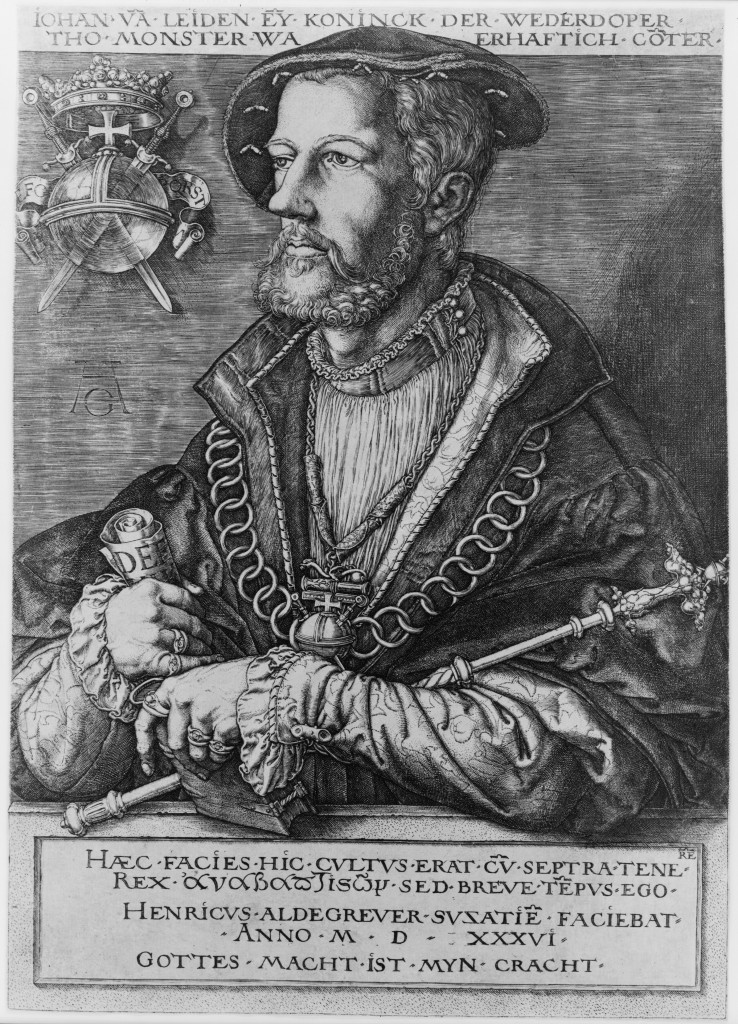
John of Leyden

Some think that English Baptists owe much to some European Baptists who originated within the European Reformation movement.  Others believe English Baptists owe little, if anything, to European Christians.  How did this happen?

In the Europe of the 1500s, the first to re-baptize Christian believers were found in Southern Germany and Switzerland.  Thomas Muntzer in 1521, had proposed a radical reformation of church and society.  He supported peasants in Mulhausen, South Germany, in a revolt against their political leaders, which would have meant the separation of church and state, a revolt which Martin Luther opposed.  Muntzer lost his life in the tragic aftermath of the revolt.  In Zurich, Conrad Grebel and Felix Manz  felt the reformer Zwingli was too timid, and they began a ‘church’ in their own home.  In 1524 they pressed for a ‘confessing church’, which would admit only adults who personally declared their faith in Christ, and they made a public stand for adult, believer baptism.  Grebel believed the church consisted only of those who made such a confession.  In an early attempt to set up the church as ‘a gathered fellowship of believers’, this community would then receive the Lord’s Supper in someone’s home..  The whole matter came to a head in Zurich in 1525 when the civic authorities banned believers’ baptism, and in1527 the civic authorities arrested Manz, who was tied to a bedstead and publicly drowned in Zurich’s River Limmat.  A church was emerging which offered a new ethic of love and non-resistance.  Balthazar Hubmaier, another Anabaptist, published a defence of toleration in matters of religion, titled Concerning heretics and those who burn them, in which he claimed that persecution was an invention of the devil.

In Europe there were, according to Dr Morris West, three kinds of Anabaptists, who had one thing in common, they did not fit into the suppositions of either Catholics or Protestants about the unity of Church and State.  Evangelical Anabaptists put Scripture at the centre of their lives, recognising it as authoritative for humanity, and capable of interpretation by the Holy Spirit. To such believers alone the benefits of the Lord’s Table to be given.  The Anabaptist Spiritualists put all their emphasis on the direct, personal inspiration of the Holy Spirit.  They played down the ‘church idea’ and had no interest in the sacraments.  There were Anti-Trinity Anabaptists, who denied the understanding of God in three persons.  These groups drew large numbers of people, because their personal commitment to being ‘living saints’ was very attractive.  They were essentially Bible Christians of a precise kind. When opponents said they had Zwingli’s word on a situation, they would reply they had God’s Word on it!  They claimed the Roman Catholic model of the Church was completely at variance with the Bible. They argued for the restitution of the New Testament Church, not the reformation of Rome.  [See W M S West, in A Gilmore [ed.], Christian Baptism, Lutterworth Press, 1959, pp.223-272]

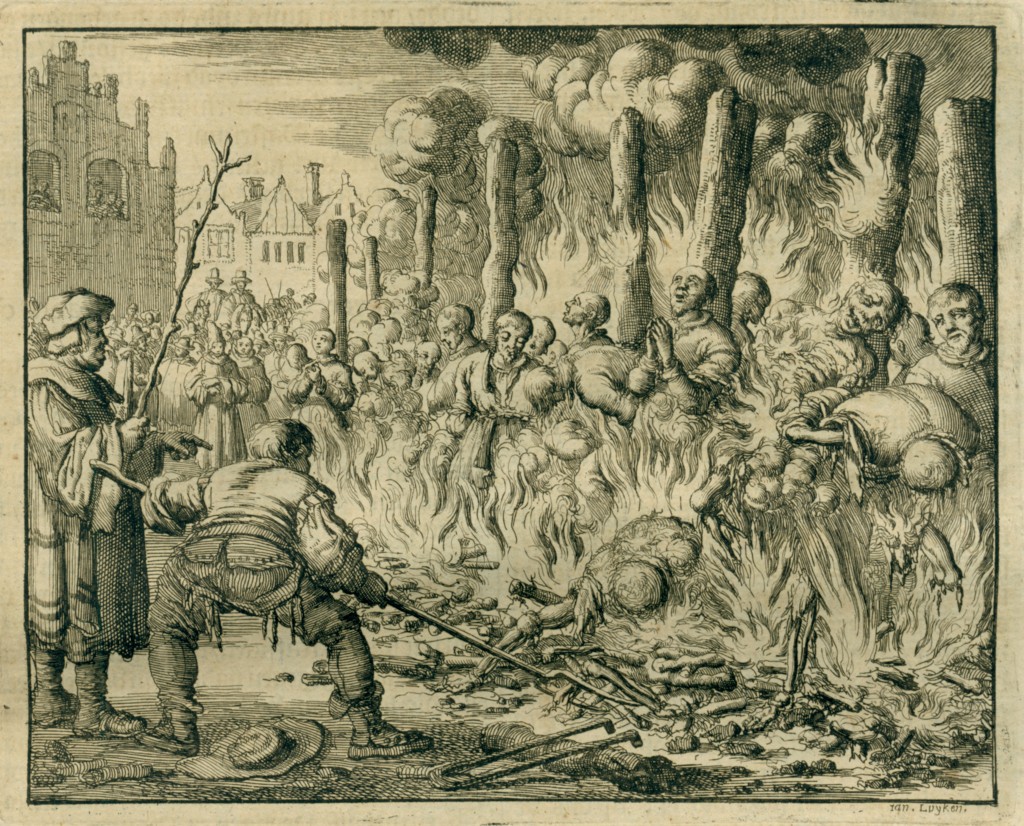
Anabaptists burned at the stake

Anabaptist political involvement in Europe resulted in a disaster which haunted Baptists for three centuries.  It happened when a group of Dutch Anabaptists arrived in Munster seeking sanctuary.  Once there, they convinced the leader of the group they joined in the city that infant baptism was wrong.  The Bishop of Munster disagreed, but died before he could enforce his will, and in 1534 the Anabaptists won an election in the city as many more refugees flooded in.  The city authorities surrounded Munster with an army.  In the fighting that followed the Anabaptist leader, Jan Matthys was killed and John, of Leyden, took control.  He proclaimed himself King, officially advocated polygamy on the basis of Old Testament precedents, and proclaimed Christ’s ‘return’ was imminent.  The end came when a deserter betrayed the city’s defences to the besieging army.  The ensuing slaughter was total.  This incident made ‘Anabaptist’ a by-word for social anarchy and political dissolution.  Some who escaped with their lives were then led by a former Roman Catholic priest, Menno Simons, and his name was later given to the successor communities which to-day are known as Mennonites, a significant community in the Europe and America.

The one English Baptist group that became involved with Dutch Anabaptists were those who, under Elizabeth I, had split from the Church of England to set up ‘separatist’ churches that ignored the ‘parish’ structures of England.  Persecution took  them to Geneva and Holland.  In Holland their leader, John Smyth, and his friend Thomas Helwys, submitted to believers’ baptism, and established the first English Baptist Church on Dutch soil.  Eventually Helwys and Smyth agreed to part, with Helwys and some of his friends setting up the first English Baptist church in Spitalfields, London in 1612.

Although many Baptists rejected the Anabaptist tag, in the light of Munster, a number of Baptists looked favourably on some of their other ideas.  English Baptists led by Helwys adopted what is called an Arminian view, others from a Puritan background took a Calvinistic view of Christianity.  What is the difference? To understand this, you need to answer to this question:  When Jesus died upon the cross, did his death mean that all people had the potential to be delivered from their sin and receive forgiveness?  Or: when Jesus died upon the cross was salvation only on offer to those who God had, in his wisdom, predestined to eternal life?  We shall consider this question in our next article.

ROGER HAYDEN   

Thursday, 8 March 2012

Who are the Baptists? What is a Baptist Church?

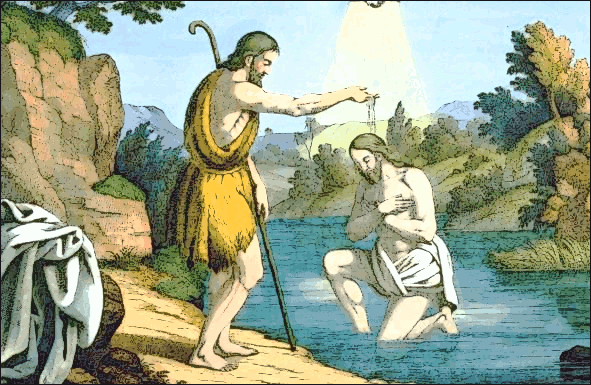
John baptizes Jesus, courtesy of http://www.wpclipart.com
People in Baptist Churches are a mixed bunch, but then, so are those in to-day’s Anglican and Roman communities!  Someone once described a Baptist as ’a person of the opposite opinion’!  Another claimed that when three Baptist are gathered together there will be five opinions.

To appreciate who Baptists are to-day, as individuals and as a community, requires some history, to identify Baptists properly.  I offer the wise words of George Santayana for your consideration, that ‘the fate of those who forget their past is to have to relive it’.  Don’t let ‘history’ put you off, reliving it can be very painful.

Two thousand years ago, a radical, rough-hewn, personality called ‘John the Baptizer’, out in the Palestinian wilderness, called people to repentance for sin, and to be prepared for the coming of Israel’s Messiah.  A sign of their response was to be baptized, by immersion, in the Jordan river.  Jesus, who came from Nazareth, became part of John’s programme, and was baptized by John in the Jordan.  When his life, crucifixion, and resurrection were completed, Jesus commanded his followers to ‘Go out and train everyone you meet, far and near, in this way of life, marking them by baptism in the three-fold name: Father, Son and Holy Spirit.  Then instruct them in the practice of all I have commanded you.’[E H Peterson, The Message, p.73]  This dramatic symbol of rebirth and commitment to Jesus, very quickly became the way of initiation into the rapidly spreading Christian communities in the Mediterranean world, and was closely identified with the observance of the Lord’s Supper, as instituted by Jesus, as commands of Christ that cannot be ignored.
As the Church grew over the centuries, variations occurred in the way baptism was performed, the appropriate age of the candidate, the exact requirements of the baptized or their sponsors, and who could baptize new Christians.  By 300 AD most new born children of Christian parents were thought to be proper recipients of baptism, though some Christian groups thought baptism should be only for people making a conscious confession of their faith in Christ, and affirmed their willingness to walk the Christian way.
It was not until the Renaissance [the re-birth of Greek and Latin literature and architecture] and the Reformation of the Church [by leaders such as Luther, Zwingli, Calvin] that the consideration of baptism came to the forefront in Christian thinking.  An important reason for this was the translation of the Bible into English.  The first English version was the Genevan Bible[1560] published with detailed commentary notes of a Calvinist flavour.  It was the Bible most widely read in private use in England until 1611 when the King James version was produced.  It was a major change in England, that all literate people could read the Bible for themselves.  This combined with the earlier invention of printing produced a church revolution.  In the early days of these changes, one young scholar, Thomas Linacre, at Cambridge University when he read Erasmus’s printed version  of the Gospels in Greek for the first time, was alleged to have declared: ‘Either this is not the Gospel or we are not the Church’.  Many others agreed as they compared the Church of their day with the pristine Gospel story.  Some of these became Baptists, finding support and encouragement from the Bible and the example of some European Anabaptists, or re-baptizers, which we consider next.         
 ROGER HAYDEN